Connect with us

Featured

The I.R.S. Moves to Allow Churches to Endorse Political Candidates, Ending A Decades-long Ban

Published

on

For years, African American churches have walked a fine line, stopping short of endorsing political candidates because the I.R.S. banned campaigning by tax-exempt entities. But in a recent court filing the I.R.S. stated that the ban does not apply to houses of worship. 

This new direction from the agency comes amid a lawsuit filed by two churches in Texas and an association of Christian broadcasters.

The plaintiffs argued that all nonprofits – religious and secular – should be free to endorse candidates to their members, challenging a fundamental understanding of nonprofit law: that 

tax-exempt groups cannot be used as tools of any campaign. 

Pastor Clarence Thornton, who owns Joynet Radio in Little Rock, AR, that specializes in Gospel music, recognizes the influence of the ruling on African American churches.

He said, “For centuries, the African American Church has stood as more than a religious institution, it has been a driving force for social change, courageously confronting injustice and advocating for the needs of our community, and by extension, the broader American society..”

But as the longtime pastor of Macedonia Baptist Church and a broadcaster, Thornton is concerned the ruling will undermine the fundamental separation of church and state as outlined in the Constitution.

“We have always stopped short of endorsing a specific candidate as a unified body of Christ, understanding that such actions would not only compromise the moral and spiritual integrity of the Church but also violate the foundational American principle of religious neutrality in government. To do otherwise is not just risky – it is clearly contrary to both our faith tradition and the democratic ideals that allow our faith to thrive.”

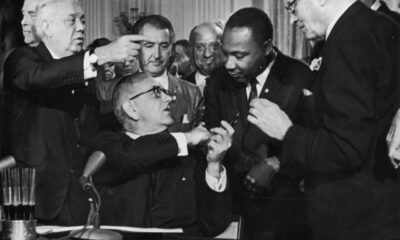
The law governing the involvement of nonprofits and campaigns has a long history, dating back to 1954 and the efforts of then-Sen. Lyndon Johnson. But as the religious right became more politically vocal, the Johnson Amendment was viewed as restrictive. President Donald Trump has long supported campaigning in churches – embracing the notion because much of his political base stems from evangelical Christians.

Continue Reading

Featured

Trump’s Use of “low IQ” Insult Reveals His View of Black Americans

Published

on

In a recent social media rant, President Donald Trump hurled his favorite insult at House Democratic leader, New York Congressman Hakeem Jeffries, calling Jeffries “low IQ” and a “thug.” Trump’s denigration came as he called for Jeffries to be charged for allegedly inciting the violence at the Washington Correspondents Dinner two weeks ago when a gunman attempted to assassinate Trump. 

In conversations held publicly around news desks and in homes, barbershops, and backyard BBQs, one of the questions that invariably surfaces focuses on whether Donald Trump is a racist. Most Black Americans have a ready answer. Mother Jones raised the question earlier this week in an article, and their analysis of his use of the insulting description, “low IQ,” offers credible evidence. 

In the last 10 years, Trump used “low IQ” 75 times, and more than half of those times, he applied it to prominent Black Americans. Here’s a look at the numbers. 

  • Vice President Kamala Harris: Targeted 23 times; Trump has called the Vice-President “very low IQ individual”.
  • Congresswoman Maxine Waters: Targeted at least 8 times; described as an “extraordinarily low IQ person”.
  • Supreme Court Justice Ketanji Brown Jackson: Attacked as “that new, Low IQ person” on the Supreme Court.
  • Minority Whip Hakeem Jeffries: Called a “totally low IQ person” and a “thug”.
  • Chicago Mayor Brandon Johnson: Targeted 5 times.
  • Congresswoman Jasmine Crockett: Referred to as a “low-IQ person” during a Meet the Press appearance.
  • Radio Host Charlamagne tha God: Labeled a “low IQ individual” in response to his public comments.
  • Other Targets: He has also questioned the intelligence of figures like Basketball Superstar LeBron James, Newscaster Don Lemon, and former Trump Supporter Omarosa Manigault Newman.

Jeffries responded with a post of his own, referring to Trump as the “dumbest” president in history.

Continue Reading

Featured

Unemployment Is Almost Double for Blacks, Yet Black Approval for Trump Has Increased

Published

on

High gas prices continue to dominate the headlines as the U.S. and Iranian stalemate over the Strait of Hormuz persists. Compounding consumer frustration–especially for Black Americans–is an unemployment rate almost double that of the national average and other ethnic groups.

For Black Americans, the March 2026 unemployment rate was 7.1% while the national average was 4.3%. Earlier in the year, the unemployment rate was even higher, fluctuating between 7.3% in January to 7.7% in February.

During the past few months, the unemployment rate among Black men and women, who are  noncollege graduates, has dropped. But overall, the unemployment rate among Black men is higher in 2026 than it was this time last year.

Black women with college degrees and those who work in public sector jobs have seen professional progress eroded under Trump’s attacks on federal workers and DEI policies.
Despite the impact of Trump’s policies on Black Americans, recent polling shows he has found an opening among a block of voters historically loyal to Democrats. A 2025 Gallup poll found  22% of Black voters approved of Donald Trump’s leadership compared to 13% in 2017 during his first term.   

Continue Reading

Black History

US Black Chambers of Commerce Makes History with Campus for Entrepreneurship

Published

on

The U.S. Black Chambers of Commerce recently unveiled its new campus, which was the former BET headquarters, located on more than seven acres in the nation’s capital.

USBC President Ron Busby, said, “When I reflect on the journey of the U.S. Black Chambers over the past 16 years, I see a story of resilience, vision, and progress. This campus is the next chapter of that story — not just a building, but a living symbol of what happens when we claim our space, own our future, and build institutions that outlast us.”

For five years, Busby worked to bring his vision of a permanent home for the “voice of Black Business” to fruition. Relying on his faith and an impressive roster of supporters, he navigated a changing political landscape and uncertainty for businesses, large and small.

The USBC Innovation Campus is about more than today’s entrepreneurs; it’s about ensuring that generations to come inherit a place where their ideas, voices, and businesses can thrive,” he explained.

Amid the upheaval of today’s economy with its growing list of mass layoffs, increased tariffs and tightened access to capital, Black entrepreneurs are finding renewed hope in efforts to build a community that helps fuel their goals.

History is on their side.

Even during slavery, some free Blacks managed to establish small businesses, and for a very small number of the enslaved, there were limited opportunities to “hire themselves out” for income. After the Civil War and during Reconstruction, there was a sharp rise in Black business ownership as men and women embraced ways to exercise their freedom. Despite the frequent threats and incidents of violence, this commitment to claim their place in spaces that had been off-limits served only to fortify their determination.

The harsh reality of Jim Crow and its relentless discrimination created a demand for more Black businesses. Entrepreneurs provided services to their communities, even though many consumers had very little discretionary income. The “internal” economies that sprang up around the country employed other African Americans and led to Tulsa’s Black Wall Street and insurance companies like North Carolina Mutual Life Insurance Company and Atlanta Life Insurance Company. Madame C.J. Walker also emerged during this era.

“My object in life is not simply to make money for myself or to spend it on myself in dressing or running around in an automobile, but I love to use a part of what I make in trying to help others” she said.

Fast forward more than a century, and the development of a campus devoted exclusively to nurture Black entrepreneurship would have been among Walker’s and the ancestors’  wildest dreams. It certainly has been one of Ron Busby’s, and he would like to see the USBC Innovation Campus play a pivotal role in helping others realize theirs.  

Continue Reading

Trending

Copyright © 2026 Love Black History, powered by WordPress.