Connect with us

Featured

The I.R.S. Moves to Allow Churches to Endorse Political Candidates, Ending A Decades-long Ban

Published

on

For years, African American churches have walked a fine line, stopping short of endorsing political candidates because the I.R.S. banned campaigning by tax-exempt entities. But in a recent court filing the I.R.S. stated that the ban does not apply to houses of worship. 

This new direction from the agency comes amid a lawsuit filed by two churches in Texas and an association of Christian broadcasters.

The plaintiffs argued that all nonprofits – religious and secular – should be free to endorse candidates to their members, challenging a fundamental understanding of nonprofit law: that 

tax-exempt groups cannot be used as tools of any campaign. 

Pastor Clarence Thornton, who owns Joynet Radio in Little Rock, AR, that specializes in Gospel music, recognizes the influence of the ruling on African American churches.

He said, “For centuries, the African American Church has stood as more than a religious institution, it has been a driving force for social change, courageously confronting injustice and advocating for the needs of our community, and by extension, the broader American society..”

But as the longtime pastor of Macedonia Baptist Church and a broadcaster, Thornton is concerned the ruling will undermine the fundamental separation of church and state as outlined in the Constitution.

“We have always stopped short of endorsing a specific candidate as a unified body of Christ, understanding that such actions would not only compromise the moral and spiritual integrity of the Church but also violate the foundational American principle of religious neutrality in government. To do otherwise is not just risky – it is clearly contrary to both our faith tradition and the democratic ideals that allow our faith to thrive.”

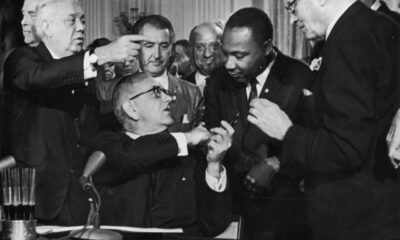
The law governing the involvement of nonprofits and campaigns has a long history, dating back to 1954 and the efforts of then-Sen. Lyndon Johnson. But as the religious right became more politically vocal, the Johnson Amendment was viewed as restrictive. President Donald Trump has long supported campaigning in churches – embracing the notion because much of his political base stems from evangelical Christians.

Continue Reading

Featured

A Timeline of the Tulsa Massacre Mass Graves Discovery on the 105th Commemoration

Published

on

The spotlight returns to Tulsa this weekend, the 105th commemoration of the Race Massacre that decimated one of the nation’s most prominent displays of Black success. After a white mob swept through the area in 1921 burning and looting, hundreds were killed and even more fled the area. Some of the dead were buried in mass graves in the southwest corner of Tulsa’s Oaklawn Cemetery.

In 2019 – almost a century after the massacre – a ground penetrating radar survey detected the presence of remains. Months later in 2020, the City of Tulsa started physically digging for bodies and mass graves. 

Since the initial 2020 dig, the city has led multiple rounds of archaeological excavations. The first mass grave containing the remains of multiple massacre victims was found in October 2020. A larger, full-scale excavation and exhumation process began in the “Original 18” site, which is connected to a newspaper article that reported 18 bodies were being held at funeral homes and would be transported to Oaklawn Cemetery because their loved ones had not claimed their bodies due to the chaos following the massacre. Many of the residents who survived were also placed in internment camps, leading to displacement and scrutiny from whites.

The most recent multi-week excavation wrapped up in November 2025, which led to the discovery of dozens of additional unmarked graves.

Historians recall the Greenwood district in 1921, also dubbed “Black Wall Street,”  as an area with hundreds of Black-owned businesses, luxury hotels, theaters, and doctor’s offices. The area rose because economic discrimination created the need for independence, but the whites, who oversaw the system of oppression, became envious of the prosperity and sought to destroy the demonstration of collective determination.

Today, only one person is still alive who survived the massacre. Lessie Benningfield Randle is 111, and she continues to fight for justice and reparations for the victims and descendants of the residents of the Greenwood district.

Continue Reading

Featured

Republican-led Redistricting Could Cost Congressional Black Caucus 1/3 of Its Members  

Published

on

The Congressional Black Caucus recently sounded the alarm, calling the Republican-led gerrymandering efforts across the country an assault on Black voter protections.

According to the CBC, 19 of its 62 members may lose their seats after the redistricting and the Supreme Court’s gutting of Section 2 of the Voting Rights Act of 1965. The high court sanctioned Congressional maps providing a “partisan” advantage, but not a racial one. Critics say the developments open the door for dramatically decreased Black representation in Congress.

Representative Yvette Clark, who chairs the CBC, described the national redistricting strategy as a “power grab.” 

CBC members and political scientists describe the mid-decade redistricting plans, which were initiated by President Donald Trump, as an attack on Black voters.

In Tennessee, the state legislature successfully split the district that includes Memphis, a predominantly Black urban area, into three districts.

“Overall, the Congressional district plan is Black vote dilution at an industrial scale,” stated Dr. Sekou Franklin, the executive director of the John Lewis Center for Social Justice at Fisk University. “It eliminates the largest urban and naturally-cohesive Congressional district, of which Black voters can elect a candidate of their choice. This has not happened since before the passage of the Voting Rights Act of 1965.”

Missouri Congressman Emanuel Cleaver, who has represented the 5th Congressional District which includes Kansas City for more than two decades, faces an uncertain future. The Missouri legislature targeted Cleaver by dividing the district, a Democratic stronghold, into three districts. The Missouri Supreme Court rejected challenges to the map, declaring it constitutional.

Vice President J.D. Vance campaigned today in the now Republican-friendly district, remarking on the U.S. Supreme Court’s ruling. 

“We had that great Supreme Court case that said a crazy thing, like maybe we shouldn’t discriminate against people based on race, right, very common sense,” said Vance.

The CBC has pushed back against the gerrymandering trend and announced plans to continue challenging the Republican efforts.

In a statement, members added: “We are working with partners in state legislatures across the South, alongside the legal and civil rights communities, to challenge these maps in court and mobilize our communities to the ballot box.”

Continue Reading

Featured

Trump’s Use of “low IQ” Insult Reveals His View of Black Americans

Published

on

In a recent social media rant, President Donald Trump hurled his favorite insult at House Democratic leader, New York Congressman Hakeem Jeffries, calling Jeffries “low IQ” and a “thug.” Trump’s denigration came as he called for Jeffries to be charged for allegedly inciting the violence at the Washington Correspondents Dinner two weeks ago when a gunman attempted to assassinate Trump. 

In conversations held publicly around news desks and in homes, barbershops, and backyard BBQs, one of the questions that invariably surfaces focuses on whether Donald Trump is a racist. Most Black Americans have a ready answer. Mother Jones raised the question earlier this week in an article, and their analysis of his use of the insulting description, “low IQ,” offers credible evidence. 

In the last 10 years, Trump used “low IQ” 75 times, and more than half of those times, he applied it to prominent Black Americans. Here’s a look at the numbers. 

  • Vice President Kamala Harris: Targeted 23 times; Trump has called the Vice-President “very low IQ individual”.
  • Congresswoman Maxine Waters: Targeted at least 8 times; described as an “extraordinarily low IQ person”.
  • Supreme Court Justice Ketanji Brown Jackson: Attacked as “that new, Low IQ person” on the Supreme Court.
  • Minority Whip Hakeem Jeffries: Called a “totally low IQ person” and a “thug”.
  • Chicago Mayor Brandon Johnson: Targeted 5 times.
  • Congresswoman Jasmine Crockett: Referred to as a “low-IQ person” during a Meet the Press appearance.
  • Radio Host Charlamagne tha God: Labeled a “low IQ individual” in response to his public comments.
  • Other Targets: He has also questioned the intelligence of figures like Basketball Superstar LeBron James, Newscaster Don Lemon, and former Trump Supporter Omarosa Manigault Newman.

Jeffries responded with a post of his own, referring to Trump as the “dumbest” president in history.

Continue Reading

Trending

Copyright © 2026 Love Black History, powered by WordPress.