Six-year-old Miriam didn’t understand why her family
suddenly had to leave her grandparents’ home in Monroe, Georgia until much
later. It was the 1960s, about eight years after 14-year-old
Emmett Till had been brutally murdered for supposedly whistling at a white
woman.
As Miriam learned later, what her brother had done seemed
just as bad. The teen had supposedly “sassed” a white woman who owned a candy
store.
“She was selling candies that were stale,” said Miriam, who
declined to use her real name. “When my brother got his candy, he said ‘Wait
up.’ He walked up to her, ‘This isn’t good. It’s stale.’”
That same day someone went to their grandparents’ home. It
turned out the woman was the wife of a Klansman. They were instructed to leave.
Like Till, the siblings and their parents were visiting relatives. They left
early the next day.
“My brother told me the story,” Miriam said. “They left
because they knew of Emmett Till.”
The image of Emmett Till’s mutilated body, which was
published by the Black press, remains fresh in the minds of many African
Americans years later. And for blacks what happened to Till had become a
cautionary tale.
“It was part of the talk,” Elliott
J. Gorn said Sunday at the Decatur Book Festival where he spoke about his
book, Let the People See. “Some families even kept the image to show
their children, as horrible as that was, because that was part of the warning
about race in America.”
But that image became a controversial point in Sunday’s
session when a member of the audience voiced what many others were thinking. He
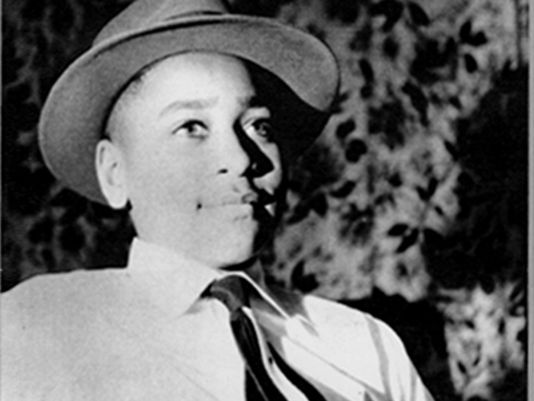
demanded to know why the more sedate photo of a smiling Till taken almost a
year before he was killed was shown for the session instead of the photo of his
disfigured body.
Sponsors of the
program admitted they decided not to show the disturbing photo. It was a
decision many said was wrong.
“We owe it to him and his mother to at least look at it and
see,” said Nicole Blackwell. “We know it’s horrible. It’s common. We like to
pretty up the past, saying, ‘It wasn’t so bad.’ We have to face it.”
And that appeared to be the point behind Mamie Till’s
decision when she spoke those memorable words back in 1955: “Let the people see
what they did to my boy.”
The 14-year-old had been visiting his uncle in Money, Mississippi
when he, his cousins and some friends drove to the little grocery store that
mostly served a black clientele, Gorn said. Carolyn Bryant, a white woman, was
working as the cashier when Till went inside alone.
Many of the reports that came out later were false. Stories
that his cousin egged him on; that he carried a picture of a white girlfriend
were untrue, Gorn said. Till was in the store for about a minute, came out and
nothing seemed to have happened.
Till’s cousins claimed the teenager then whistled at Bryant,
Gorn said. “His cousins and friends realize, ‘Oh, my God.’” They dove back into
their car and headed home, he said.
“It felt like the danger had passed,” Gorn said. Then three
nights later, Bryant’s husband, Roy, and her brother-in-law, J. W. Milam, showed
up at the home. They were armed. They knocked on the door and took him away.
Till was never seen alive again.
Three days later, they found his body in the Tallahatchie
River.
“The immediate effort of the authorities was to bury his
body there,” Gorn said. “There was a grave already dug.”
But Mamie Till asked her Congressman, an African American on
the southside of Chicago, to prevail upon the Mississippi officials. She wanted
her son’s body to come home. They managed to get the body and Till was
horrified at the sight of the son she had sent to the South days earlier to
visit family.
She was horrified and decided to let the people see what
they did to her son, Gorn said.
“If you think about it, if you think about the courage that
it would take for a mother to allow it; to let the world see what had happened
to her son, the mutilation,” Gorn said.
She allowed his body to lie in the funeral home, then at the
Church of God in Christ on State Street in Chicago for a week. Thousands of
people passed by the coffin of Emmett Till, almost all were African Americans.
The police estimated a hundred thousand viewed his body, Gorn said.
“They don’t know who Emmett Till is,” Gorn said. “But they
know that this story, somehow they know this story is their story.”
The image of Till’s face appeared in Jet magazine; it
appeared in The Chicago Defender and other black newspapers, Gorn said.
“It didn’t show up in the white newspaper until 30 years later. Very few white
people saw that image.”
But, he added, “African Americans saw it. They saw the
photo, even if they weren’t subscribers of Jet. They passed that photo around.
So many memoirs, Civil Rights Memoirs, talk about the importance of this story,
talk about the importance of the photograph. The black press covered it very,
very deeply. The white press covered the story, but they never showed the
photo.”
Till’s death became a catalyst for the Civil Rights
Movement. Black leaders like Representative John Lewis and Muhammad Ali, all
talk about seeing the photograph, Gorn said. “They all saw that image. They
were about 13 and 14 years old and they talk about how this is just a moment
that galvanized them.”
When Bryant and Milam stood trial and were found not guilty,
the news was so huge it made the foreign press. It was during the Cold War and
the United States was trying to present a global image as a beacon of Democracy,
Gorn said.
“But, the foreign press wondered, ‘What kind of beacon is
this where they murdered a child for allegedly whistling at a woman and the
murderers are found innocent?’” he said.
At that time thousands had been lynched in the South with
Mississippi leading the way. But Till’s story stood out because of his age and,
Gorn said, the photo.
In 2005, The FBI reopened the case and instead of an
all-white jury, which was the case in 1955, there was a mixed grand jury.
Still, the jury declined to indict Carolyn Bryant who reportedly recanted her
story, but then she said she never recanted, Gorn said. By then Till’s
murderers had already died. Milam died of cancer in 1981 and Bryant, who had
become blind, died of cancer in 1994.
Over the course of time, Bryant changed her story to say
Till laid his hands on her, threatened her and told her he would be back, Gorn
said. It had become a case of would-be rape.
But Gorn found something startling from the FBI’s documented
interview of her sister-in-law who was in the living quarters of the store at
the time.
“At one point, Juanita Milam said, ‘Yeah, I never understood
why there was so much to-do about just a whistle or a wink.’ And the FBI agents
who had been investigating the case, at this point for months, they understand
something important had just happened.”
“’What do you mean a whistle or wink?’” the agents asked.
“’Just, it never made sense to me that all of this, the
death of Till and all of this just happened because of someone winking at her.’”
“’What are you talking about?’” they insisted.
Milam told the agents Bryant was alone in the store for the
first time and that she was scared.
“It was twilight, it was dark. It was Till and his friends.
There were some other young African Americans on the porch, playing checkers
and she was scared. And she implies this story was simply made up,” Gorn said.
Still, Milam’s words remained impotent. Nothing changed.
Then,
in 2018 the Department of Justice reopened the investigation into the
teenager’s murder, citing “new information.” The DOJ declined to share
details, but in the book The Blood of Emmett Till, author Timothy B.
Tyson quotes Carolyn Bryant as saying she had not told the truth when she made
the allegations against Till. One year
later, there is still no final word from officials.
Meanwhile, parents continue to talk about what happened to
Emmett Till with their children.
Nigel Savage, 14, said he knew about Till’s story before he
showed up at the session Sunday. His parents had made sure the teen knew.
“It makes me feel that I always have to be aware of what I’m
doing and my surroundings,” the teen said. “Not scared, but cautious.”
His parents began telling him about Till at an early age.
“We are an African American family living in the South,”
Angela Savage said. “The hatred that led to the death of Emmett Till still
exists in this country. He didn’t do anything and his relatives were not able
to protect him from the brutality. It’s a sad and unfortunate history black
people had to endure. I don’t want to repeat it, but we don’t need to forget
it.”
Gorn said the story of Till will never go away. “It’s an
African American story, it’s a Southern story and it’s an American story.”













 Black History7 years ago
 Black History8 years ago
 Black History6 years ago
 Black History7 years ago
 Black History7 years ago
 Black History8 years ago
 Black History11 years ago
 Black History6 years ago