As a
genealogist, K. I. Knight deals with hundreds of names, yet one name lingered
in her mind. It was with her when she was driving, working or running errands.
That name: Margaret Cornish.
The name kept
pulling her and, finally, Knight gave in. She had to find out more about this
woman and how she survived. A young Margaret Cornish had been stripped of her
belongings, beaten and taken from her home in Angola along with 349 other
Africans.
She survived
thousands of miles in the narrow underbelly of a packed Spanish ship with dead
and dying Africans to make it to the New World. And, she became one of the
first Africans to land and live in England’s colonies in North America.
Knight, who
is white, then made a shocking and unexpected discovery. This woman, who had given
birth to five children, had also given birth to one of her relatives, a great
grandfather many generations before.
“I sat and
cried for an hour,” Knight said. “I was happy because I knew why I couldn’t get
away from this woman.”
This month, Knight
will be among the dozens who will gather on Virginia’s soil to participate in
the 400th commemoration of the first Africans’ arrival to the United
States. But she won’t just be honoring the memories of those who left an
indelible imprint on history and changed the course of America, she will be
honoring her family. And she won’t be the only one. There will be other
descendants participating in the events, which are planned for Aug. 23 through
Aug. 25.
Knight spent
11 years researching and publishing three books on the first Africans, but only
discovered two years ago that she was related to Cornish. Thinking of Cornish’s
journey to the colony of Virginia, Knight is awed by the realization that if things
had gone as planned, she wouldn’t have existed. If Cornish had been allowed to
live out her life in her homeland, or the ship she was on had not been
attacked, then Knight wouldn’t have been born and the colony of Virginia,
Knight believes, would have ceased to exist.
Fateful Beginning
Cornish came from Ndongo, which was located in modern-day Angola. It’s capital, Kabasa, was a grand city occupied by artisans and
bustling with merchants from various regions who had traveled to the
Bantu-speaking kingdom to sell their commodities in the city’s international
market.
Educated by Portuguese Jesuits, the kingdom was mainly
Catholic. The Africans spoke different languages and knew how to barter and
trade, said Knight whose thousands of hours of research on the first Africans
resulted in her first book, Unveiled: The Twenty & Odd.
When a young, inexperienced king took the throne, the Portuguese
hired headhunters to attack Angola. The king fled in fear, leaving his citizens
to be captured and 350 of them to be forced aboard the San Juan Batista. A
third died during the journey and 24 of them were sold for food and medicine.
Another 60 faced a different fate. The captains of the pirate
ships, the Treasurer and the White Lion, had been roaming the seas for weeks looking
for a wealthy target when they spotted the San Juan Bautista and launched an
attack.
When they finally boarded the defeated Spanish ship, instead of
gold they found human cargo. Unwilling to leave empty handed, they each took 30
of the healthiest Africans. They planned to take them to the colony of Virginia
and there sell them for food.
“It’s just mind
blowing. You never think you’re going to find out your ancestors are documented
in such a way…to be able to connect it all the way back to Africa. That’s very
powerful.”
Tiffany
Huntsman, Descendant
But the ships encountered a severe storm and were separated. The White Lion, which Cornish was on, was the first to
arrive at Point Comfort where more than 20, believed to be between 8 and 25
years old, were sold for food. The date was Aug. 25. The other ship arrived
days later, but because of an expired marque the captain sailed away before
being captured. The ship would go to Bermuda and England before returning to
Virginia.
In the new world, the
Africans adapted. They ended up saving the colony and its settlers who,
ignorant of farming, had been relying on the Native Americans. But when a war
broke out between the two, many of the settlers were killed while others
starved to death – some reportedly resorted to eating the dying to survive.
This first generation of enslaved Africans brought to Virginia
were skilled farmers, herders, blacksmiths, and artisans. They were
accomplished traders. They also brought many ideas and innovations including
food production and crop cultivation.
With their help, the Virginia colony was able to grow cotton
and tobacco until eventually they were exporting around the world, according to
Calvin Pearson, founder and president of Project 1619. The Africans built
homes, schools and churches. They built roadways and communities.
“If not for these Africans who had arrived, Virginia would
not have survived,” Knight said. “It was their knowledge that allowed Virginia
to stay afloat because they were starving. When the Africans came it was the
best thing that happened in Virginia. They sold horses, cows and livestock. They
were sought-after breeders.”
They also started families, marrying other Africans, Native
Americans or white indentured servants before it became illegal. Since slavery
did not exist in Virginia at that time, a census from that time showed the
Africans were called servants. Historians referred to them as servants or
enslaved Africans.
Finding Family
Tiffany Huntsman’s daughter could easily be considered white,
the product of an interracial marriage. So, one day when Huntsman’s mom took
her into a public restroom, a white woman followed.
Ignoring Huntsman’s mom, she asked the child if she was okay
and where her parents were. Huntsman’s mom became angry.
“This is my granddaughter!” she said.
The woman reluctantly backed down. But the story was too familiar.
Huntsman, whose mother is black and father is white, said she encountered it
all the time, people thinking she was white or asking her what she was mixed
with. Though, she found their attitude and questions upsetting, she realized
she also wanted to know. She wanted to be able to tell her three children about
their family’s history.
She began her
research and the information she uncovered pointed her to Congo. She also took
a DNA test and the result overwhelmed her. It pointed her to John Gowen (Goins),
one of the first Africans. Cornish and Gowen had one child, a son, before
Cornish ended up with a white servant with whom she had four children, Knight
said.
“It’s just mind blowing,” Huntsman
said. “You never think you’re going to find out your ancestors are documented
in such a way. Other people are not able to trace their lineage that far. But
to be able to connect it all the way back to Africa. That’s very powerful.”
Huntsman started keeping track. She traced the Gowen line,
where they lived and the time during which they lived. She placed the
information in an online forum and compared it with the information from
others.
Since then Huntsman has found about a hundred relatives,
including one who still lives in Angola. She has contacted some of them including
Knight whom she met on the forum. So far, she has been to two family reunions
including one last summer in New Orleans. Now she knows she has relatives in
Ohio, Virginia, and Washington, D.C. She has relatives in Indiana, South
Carolina and Louisiana.
Huntsman said her mother grew up in Michigan around a Gowen family, but never realized they were her relatives.
She told her mother, “Look you have family who is African
who is still in Africa.”
But her mother didn’t want her digging into her ancestry,
saying “’Why do you want to dig up the dead? Maybe they don’t want to be found.
Maybe they want to be left alone.’”
She told her brother. He became quiet.
“Are you ok?” Huntsman said to break the silence.
Then she realized, he was crying.
“This is a huge thing,” he said. “This is a big deal.”
Hunstman understood. “Now we have this privilege of being
able to identify who our ancestors were, where they came from. That realization
hit my brother hard. I mean he was crying. Here in the U.S., a lot of people
feel disconnected from Africa,” Huntsman said. “I know people feel like it is
the mother country and we need to go back. But where, which country, what
tribe?”
Now Huntsman has the answer for herself. She also knows
another important truth.
“They weren’t brought here as slaves, that’s been a huge
realization,” Hunstman said. “There’s a misunderstanding about that because a
lot of people don’t think Africans came here before the transatlantic slave
trade. It’s just powerful.”
On
Aug. 24, many will come together to commemorate the day the first Africans
landed including dignitaries from Africa. There
will be a procession to the fishing pier for the flower petal throwing ceremony
where they will throw petals on the water to represent the lives lost during
slavery, and at the end there will be free concert at the Hampton Coliseum
featuring the Sounds of Blackness.
There will also be a dedication of the Fort Monroe Visitor
and Education Center. The new visitor center will tell the story of the first
Africans. And the next day will be the Healing Day Ceremony, which will include
a National Bell Ringing in which churches and communities around the nation are
invited to ring their bells for four minutes, beginning at 3 p.m. on Aug. 25.
Knight plans to participate in the commemoration as a
speaker during a program on Aug, 23 as well as release her third book in the
series, Fate and Freedom. But she won’t be the only descendant participating
in the commemoration.
Honoring Family
Carolita Jones Cope was born and raised in Virginia. She
remembers how her grandfather used to talk about their history. One day, he
pointed to a plot of land that now houses a petting farm.
“’We used to own that land,’” he told her.
But she was young and had no interest in her history. Her
cousin was different. She listened and yearned for more information. Her
digging uncovered a remarkable truth. Her family was the descendant of two of
the first Africans, Isabella and Antony Tucker. Cope was excited. Now she
wanted to learn more.
Since then, the family has formed a society, The William
Tucker 1624 Society, named after Isabella and Anthony’s son. William Tucker was
documented as the first child born and raised in the colony.
The Society’s biggest contribution to date is the
transformation of an old cemetery that was referred to in a deed as the Old
Colored Graveyard.
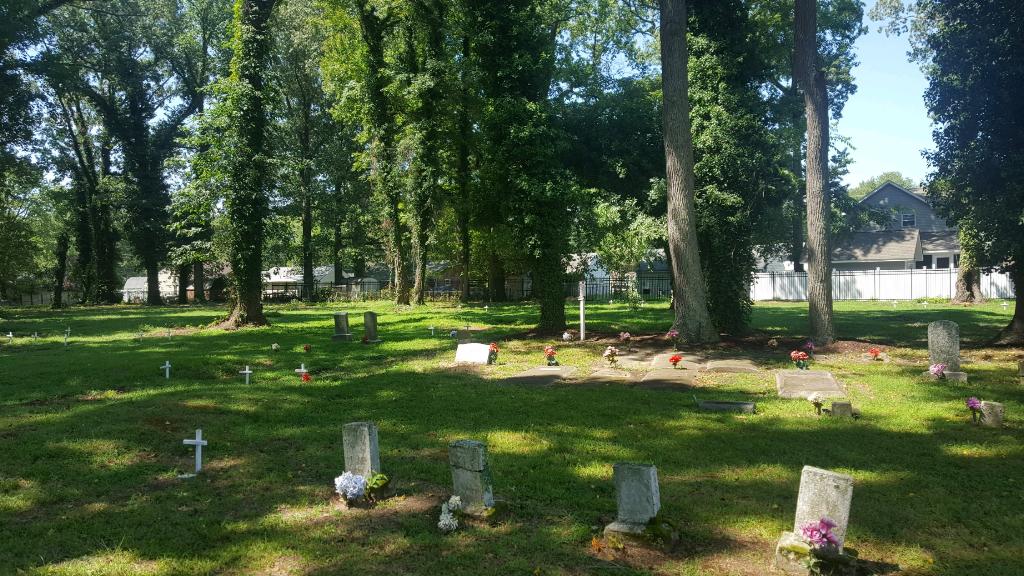
The graveyard, renamed The Tucker’s Cemetery, was
overgrown and had become a kid’s playground. Still, from time to time residents
would still bury their loved ones there. Cope said they buried their uncle
there and did some cleaning up in order to make it look more presentable.
It was during that cleanup, they discovered headstones
and indentations that made them realize there were more bodies there. In fact,
with the help of technology, they discovered dozens of unidentified graves that
they believe belong to Africans. The city of Hampton has since dedicated the
graveyard as an historical site, Cope said.
The family is hosting their ceremony with speakers,
singing and pouring of libation on Aug. 23 at the cemetery, which is less than
a mile from the plantation where her ancestors were enslaved. For the commemoration,
they have placed white crosses on each of these unidentified graves.
The ceremony, they said, is to,
“pay homage to their sacrifices and tremendous contributions in the
building of this great Nation.”









 Black History7 years ago
 Black History8 years ago
 Black History6 years ago
 Black History7 years ago
 Black History7 years ago
 Black History8 years ago
 Black History11 years ago
 Black History6 years ago