
Black History
Save the Date: August 25 Marks the 400 Year Commemoration of Africans in North America

It was described as an area overrun with natural resources. Pine trees covered the north end while various plants and animals occupied the rest. Birds flocked to Mill Creek, which was overrun by marine life and at the bottom of the Chesapeake Bay, lay a bed of oysters – an important food source for the Native Americans who valued the area as an important hunting and fishing camp.
But little remains of this area which was in Hampton, Virginia. And centuries later, it is being remembered for something else – the landing ground for the first Africans.
Their arrival in 1619 at Point Comfort in Virginia changed the course of America’s history. This month many are commemorating their arrival, and how the knowledge they brought and skills they invested rescued the dying colony. In the end, not only did they endure, they thrived. They and their descendants built this nation, according to historians. And transformed it.
“They didn’t just survive, they created new music, new art forms,” said Terry Brown, Superintendent, Fort Monroe National Monument, National Park Service, in Virginia. “They reclaimed their heritage. They created vibrant responses to American democracy. It’s one of the greatest survival stories in American history. We created new families, new traditions. Our contribution is beyond measure.”
Last year, the 400 Years of African-American History Commission was established to create events that would highlight those contributions. But with no funding from Congress, the commission has done little.
Brown, who is a member of the Commission, realized he had to do something, especially with Port Monroe, formerly Point Comfort, playing such a pivotal role.
He said, “This is the state where they landed. People started calling, asking me, ‘are you doing anything?’”
He joined forces with the National Park Service, the Fort Monroe Authority and the city of Hampton to create a grand commemoration spread over two days. Now, he can tell those who call, they are doing a lot.
He tells them about the walking tour and the campfire talk centered around African American history. They will see the marker where the 20 and odd landed, the Contraband Bridge where they were enslaved and freed centuries later. General Benjamin Butler’s “Contraband Decision” in 1861 provided a route to freedom for thousands of slaves during the Civil War. It was the forerunner for President Abraham Lincoln’s Emancipation Proclamation of 1863.
President Barack Obama’s Proclamation
“Old Point Comfort marks both the beginning and end of slavery in our Nation,” then- President Barack Obama said in his proclamation of the Fort Monroe National Monument on Nov. 1. 2011.
“Known first as “The Gibraltar of the Chesapeake” and later as “Freedom Fortress,” Fort Monroe on Old Point Comfort in Virginia has a storied history in the defense of our Nation and the struggle for freedom.”
In his statement he debunked the myth that had been taught for generations, that the first Africans landed in Jamestown.
“The first enslaved Africans in England’s colonies in America were brought to this peninsula on a ship flying the Dutch flag in 1619,” Obama said. “Two hundred and forty-two years later, Fort Monroe became a place of refuge for those later generations escaping enslavement.”
Still, many aren’t aware of this history. And for them, this month will come and go like any other. Brown and others are trying to change that.
“The nation doesn’t even know its 400 years,” Brown said. “It’s breaking my heart. I think people only recognize us during Black History Month. They ignore us every other day.”
There’s a reason for that. He said, “There is a complete ignorance of what role African Americans play in this country. When they talk about African American history, they think it’s just African American history when it’s American history. They don’t think it pertains to them when it’s America’s story.”
He hopes the commemoration ceremony and the information shared will change that. But he knows it will be a struggle. After all, 400 years have passed, but the lies still persist about who the first Africans were, where they landed and what they did.
But Brown knows the truth and each morning when he comes to work, he sees that history. His office is two-hundred yards from where they landed in Point Comfort, today’s Port Monroe. And he has learned of their journey.
African Landing Day Commemoration
After the Portuguese hired headhunters to attack Angola, 350 Africans were stripped of their belongings, beaten and bound and packed inside the San Juan Batista in 1619.
The ship was heading to Mexico when two English corsairs, hoping to find gold, attacked the Spanish galleon-type sailing ship. Instead they found the Africans and took 60 to cover their loss. These Africans had wondered at their fate as they watched more than a third of their fellow Angolans, some they likely knew, die from sickness while a few were sold for medicine. But these 60 were strong and among the healthiest. And so, they were picked by the captains of the White Lion and the Treasurer.
But the ships encountered a severe storm and were separated, the White Lion was the first to arrive at Point Comfort where more than 20, believed to be between 8 and 25 years old, were sold for food. The date was Aug. 25. The other ship arrived days later. In a new world, the Africans adapted. They ended up saving the colony and its settlers. The English settlers didn’t know how to farm and had been relying on the Native Americans.
But when a war broke out between them, many of the settlers were killed while others starved to death – some resorting to cannibalism to survive.
This first generation of enslaved Africans brought to Virginia were skilled farmers, herders, blacksmiths, and artisans. They were accomplished traders. They also brought many ideas and innovations including food production and crop cultivation.
Because of them the remaining English settlers survived. K. I. Knight, author of Unveiled: The Twenty & Odd, said, “it was a stroke of luck for America that they arrived. I don’t believe America would have existed, certainly Virginia wouldn’t have been a colony,” Knight said.
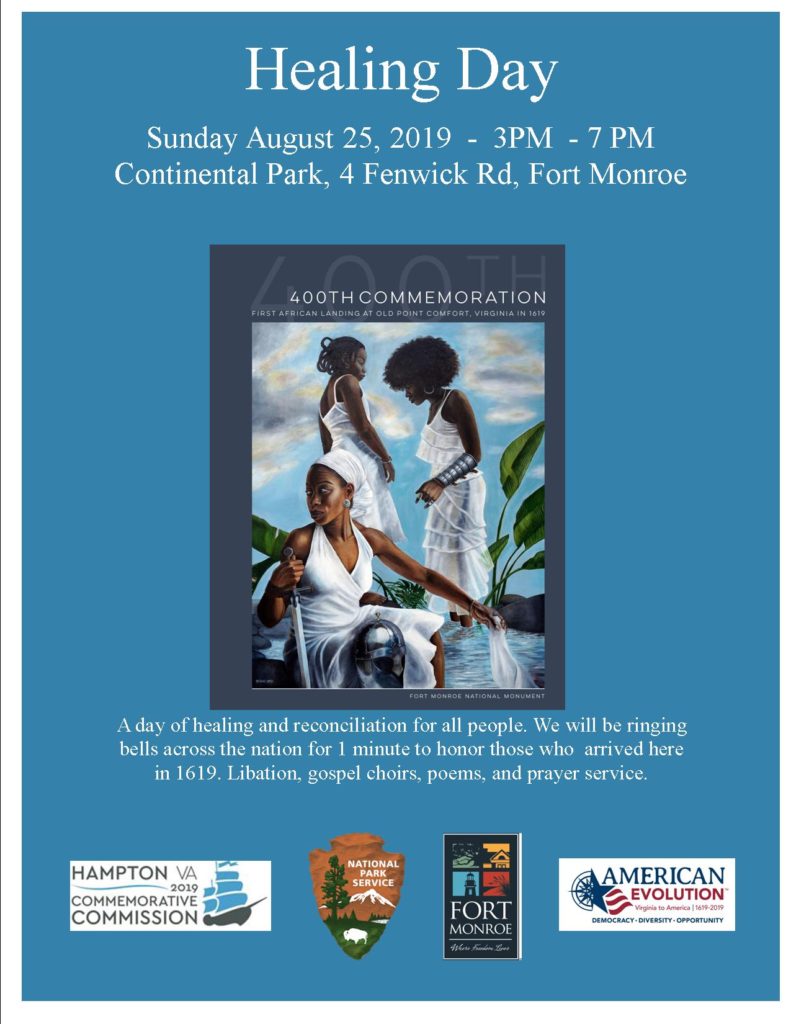
On Aug. 24, many will come together to commemorate the day the first Africans landed with cultural demonstrations, vendors, children’s activities, and more. Black Cultural Tours will be also be offered from 12 to 4 p.m.
The day’s lineup will also include dignitaries from Africa including the tribal king from Cameroon and people sent by the president of Ghana, the KanKouran West African Dance group will perform and an African Naming Ceremony will be conducted. There will be a procession to the fishing pier for the flower petal throwing ceremony where they will throw petals on the water to represent the lives lost during slavery, and at the end there will be free concert at the Hampton Coliseum featuring the Sounds of Blackness.
The program will begin at 6:30 a.m. with a spiritual cleansing at Buckroe Beach before moving to Continental Park. At 9:30 a.m. there will be a dedication of the Fort Monroe Visitor and Education Center. The new visitor center will tell the story of the first Africans. And the next day will be the Healing Day Ceremony.
It will be a day of healing and reconciliation for everyone, said Calvin Pearson, founder and president of Project 1619, which was formed to tell the story of the first Africans. His organization helped to plan many of the events.
“It’s not just for Africans, but also for those who enslaved and oppressed us,” said Pearson whose organization helped to plan many of the events.
Healing Day Ceremony
Though they were enslaved, they were not considered slaves and were sometimes referred to as servants. But there were still wide disparities between them and the white indentured servants.
The white indentured servants were still legal subjects of the English crown and entitled to certain protections including a contract that ensured their freedom after seven years. But the Africans were different. They were aliens. They had to work 15 to 20 years to get their freedom – and this was often at the discretion of the plantation owners. Still, some fought in the courts for their freedom and that of their families.
In the end, most, if not all, gained their freedom. Some intermarried while others escaped with white indentured servants.
But gradually the laws changed. “They became early America’s indispensable working class—fit for maximum exploitation, capable of only minimal resistance,” Ta-Nehisi Coates said in his article, A Case for Reparation.
In 1661, chattel slave labor law began and over the next 200 years the laws ensured that they remained nothing more than commodities. Black people were reduced to a class of “untouchables” while all whites were raised to a level of citizens, Coates said. Intermarriage became illegal, everyone except Blacks could carry weapons and once again the Africans were stripped of all property and belongings. And on their backs and with their blood a nation was built.
“Africans’ free labor built America,” Pearson said. He said they built roadways, churches, schools and communities. They built the memorials and monuments that America treasures as part of its history. “Every major city and historical building built between 1619 and 1865 were built by Africans free labor,” he said.
Still, recognizing and honoring this truth means little to many, Brown said. “Many don’t believe their history is relevant. And so, he said, the unawareness is pervasive. People just don’t know. That’s a black and white thing. People just don’t know 400 years is here.”
To honor those years, the commemoration will also include a National Bell Ringing Ceremony in which churches and communities around the nation are invited to ring their bells for four minutes, beginning at 3 p.m. on Aug. 25. On that day, there will also be songs by gospel choirs, poetry, a prayer service as well as a libation ceremony.
Still for Brown, who moved from Boston to Virginia in 2016 to take the superintendent position, there was a far more thrilling experience awaiting him. He attended an event soon after he arrived and some people he didn’t know had joined him to take a picture. He was curious to know who they were and awed when he found out. They were the descendants of two of the first Africans to land in Virginia.
“That blew my mind,” Brown said. And there were many of them, he said. Some of them will participate in the commemoration honoring their ancestors whose courage laid the foundation for an entire race of people in a new land.







On the 25th Anniversary of 9-11, America Remembers

Why Most Black Americans Think Nolan Wells’ Death and Two Recent Hangings Are Murder

August is Black-owned Business Month, and There’s Good News


-
 Black History7 years ago
The Idlewild Resort: Once the Largest, Most Successful Resort in the Midwest for Black People
-
 Black History8 years ago
Meet Sarah Boone, the Woman Who Patented the Ironing Board
-
 Black History6 years ago
Charles Baker: African American Inventor of Friction Heat
-
 Black History7 years ago
Auburn Avenue: The Richest “Negro Street in the World”
-
 Black History7 years ago
Boley, Oklahoma: One of the Last All-Black Towns Still Standing
-
 Black History8 years ago
Meet Elijah McCoy: The father of Lubrication, the Real McCoy
-

 Black History11 years ago
Ursula Burns, From Intern to CEO
-
 Black History6 years ago
Five Facts to Know About the Civil Rights Act of 1964 on its Anniversary